
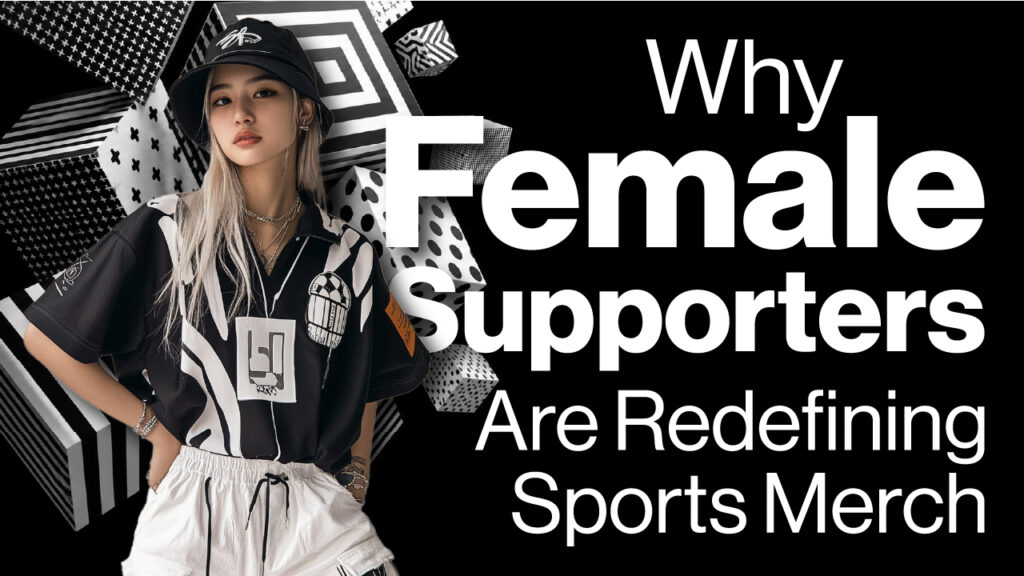
Female supporters are redefining sports merchandise across sport, influencing how teams, competitions and sporting organisations appear in fan sub-culture.
In football, Formula One, basketball, tennis and major global events, women are bringing greater attention to fit, styling, quality, versatility and personal expression.
For clubs, leagues and governing bodies, this creates a clear commercial opportunity. The next generation of merchandise won’t be shaped by smaller versions of existing products. It’ll be shaped by a better understanding of how supporters want to wear identity, culture and belonging every day.
Female Supporters Are Changing the Merch Brief
The next evolution of sports merchandise is being shaped by what supporters choose to wear when they leave the stadium.
Across global sport, female fans at the centre of this evolution. This isn’t limited to women’s leagues or women’s events. It’s visible across football, Formula One, basketball, tennis and major international tournaments.
The 2026 FIFA World Cup made that shift particularly clear.
Female supporters are engaging with the event as passionately as their male counterparts, while bringing fashion, styling and personal expression more visibly into supporter culture.
Recent media coverage has shown young women using vintage shirts, nostalgic references and football imagery to create their own place within World Cup culture. For some, fashion is an entry point into the sport. For others, it’s a way to reinterpret what supporting a national team can look like.
Female supporters aren’t simply participating in an established merchandise category.
They’re raising the expectations placed upon it.
Female supporters are no longer a secondary market, they’re helping shape the future of the category.
The Global Merch Design Brief Has Changed
Sports merchandise was traditionally developed around a fairly narrow view of the supporter on game day: the playing jersey sat at the centre of the range, followed by familiar variations of caps, scarves, polos and basic branded apparel.
Products aimed at women were often adapted from the men’s range through smaller sizing, altered colours or more fitted cuts.
That approach treats female supporters as an extension of a male market. It doesn’t recognise their influence on the direction of the market itself.
Female supporters often view merchandise through a broader design lens.
Representation still matters, but so do:
- silhouette
- fit
- quality
- versatility
- styling potential
- contemporary fashion
- adaptability across different settings
A sports branded product still needs to communicate allegiance. But it also needs to earn a place in an everyday wardrobe. And it doesn’t always need to be as literal as a match-day jersey.
These aren’t exclusively female expectations. They’re increasingly the expectations of the modern supporter. Female fans are simply making the shift more visible.
The strongest merchandise can represent a team and still be considered, contemporary and wearable.
Representing your team and dressing well are no longer opposing ideas.
From Supporter Uniform to Personal Styling
The official jersey will always play an important role.
It creates immediate recognition. It builds unity. It remains closely connected to match day and the live sporting experience.
But it’s no longer a complete merchandise strategy.
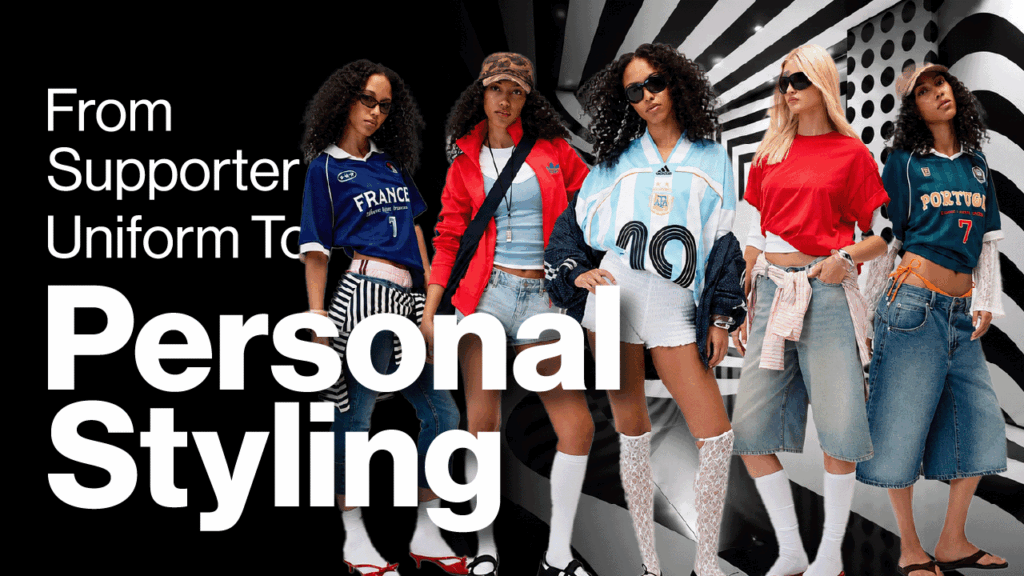
Supporters now carry sporting identity into travel, work, social occasions and daily life. A jersey might be worn with fashion pieces rather than as part of a complete supporter uniform.
In many cases, the jersey may not feature at all.
Fans are looking for apparel and accessories that align them with their team without feeling like another version of the same product.
Even major global sportswear brands are now presenting collections around style, comfort and casual wear, not simply tournament attendance.
That’s a meaningful shift. But styling a jersey differently is only one step.
The deeper opportunity is how to create merchandise that’s designed for everyday life from the beginning.
At Font & Swatch, we see this as a move away from merchandise designed primarily to identify supporters and towards apparel that lets them express their connection in a more personal way.
That distinction should guide the design process.
The question isn’t only, “Will supporters wear this to the game?”
It’s also, “Will they choose to wear it when there is no game at all?”
Two Logos Don’t Necessarily Create a Stronger Idea
The growing relationship between sports and fashion brands is often presented as proof that merchandise is moving beyond gameday and responding to female fan influence.
Some collaborations genuinely achieve that. Many, however, remain built around familiar logo-placement models.
The club logo appears beside the fashion label. The partnership creates publicity, scarcity and a temporary point of interest. Instead of one recognisable mark, there are now two.
That may create a strong launch. It doesn’t automatically create a meaningful piece of sporting culture.
Collaborations built mainly on sponsor brand recognition can date quickly because their relevance is tied to the announcement, the participating label and the release cycle.
Once that moment passes, there may be little left connecting the product to the deeper identity of the sport.
Supporters are increasingly recognising these tie-ups for what they are: promotional partnerships. Moving from gameday to everyday requires more than placing a sports logo on a fashionable silhouette.
The product needs an idea behind it.
That idea might come from an iconic moment, a supporter ritual, a particular era, a place, an athlete, a shared memory or a significant part of the brand’s history
Fashion can provide a contemporary expression. It can’t substitute for substance.
A collaboration can create attention. Meaning creates longevity.
The Female Audience Is Commercially Significant
The commercial growth surrounding women in sport adds even more weight to this shift.
Deloitte forecasts that global women’s elite sports revenues will reach at least US$3 billion in 2026, representing significant year-on-year growth.
Nielsen Sports and PepsiCo have also projected substantial growth in the global women’s football audience through to 2030, with women expected to make up a large share of that audience.
Those figures relate directly to women’s sport, but their implications extend across the wider industry. They demonstrate the scale, enthusiasm and commercial influence of female audiences.
They also reinforce something sporting organisations need to understand: women aren’t simply spectators within the market. They’re cultural drivers with broad interests across sport, fashion, music, travel and lifestyle.
That’s why identity alignment matters so much.
Sporting organisations shouldn’t view women as a secondary merchandise segment to be addressed after the main range has been developed.
Female supporters are already helping shape:
- product expectations
- visual language
- styling
- retail behaviour
- cultural relevance
- definitions of fandom
The opportunity isn’t to create a token women’s collection.
It’s to recognise female supporters as active participants in the future of the brand.
Female supporters aren’t waiting for the merchandise category to catch up. They’re already showing it where to go.
Better Merchandise Begins With Better Identity
The most effective sports merchandise doesn’t begin with product.
It begins with identity.
- Who is the supporter?
- What do they want to express?
- Where does the brand live in their daily life?
- Which parts of the club, competition, athlete or event carry meaning beyond the fixture?
At Font & Swatch, this is where the conversation becomes more interesting.
Powerful sports brands aren’t built by placing marks on products. They’re built by understanding the emotional connection people already have and giving that connection a more relevant expression.
This is why logo-first merchandise often reaches its ceiling quickly.
A logo creates recognition. But moments, memories, culture and belonging create connection.
That connection gives the product a reason to exist beyond the match.
The strongest merchandise doesn’t simply display the brand. It expresses what the brand means to the supporter.
The Opportunity for Sporting Organisations
The next phase of sports merchandise won’t be won by the organisations that simply produce more apparel.
It’ll be won by the organisations that understand how supporters want to wear belonging.
For clubs, leagues and governing bodies, this means reviewing merchandise strategy through a broader lens.
Questions worth asking include:
- Are female supporters meaningfully represented in the design process?
- Is the range based on real fan behaviour or inherited assumptions?
- Can products move naturally between stadium, street and everyday life?
- Does the merchandise reflect the brand’s culture or only its logo?
- Are supporters given ways to express identity beyond match day?
- Is the retail experience designed for discovery, styling and collection?
- Does the product carry meaning after the campaign or collaboration ends?
These aren’t cosmetic questions.
They’re commercial questions.
The organisations that answer them properly will be better positioned to create stronger emotional connections, broader cultural relevance and more valuable merchandise opportunities.
The Future Is Already Visible
Female supporters are showing sport what it’s already becoming.
More cultural.
More expressive.
More visual.
More personal.
More wearable.
This is the next stage of sports merchandise.
Not smaller versions of the same products. Not token collections. Not surface-level fashion partnerships.
A more considered brand expression for supporters who want to carry their connection to sport into everyday life.
That’s where the opportunity sits.
And the organisations that recognise female supporters as drivers of the future, not simply as a demographic segment, will be better positioned to create sports brands that connect, evolve and endure.
The future of fan merchandise won’t be designed around old assumptions.
It’ll be shaped by the supporters already changing them.
Explore Origins by Font & Swatch
Origins is Font & Swatch’s approach to sport culture wear.
We transform sporting history, culture, nostalgia and fan emotion into fashion-led merchandise designed for everyday.
To explore how your club, league or governing body can move beyond the logo and beyond gameday, contact Font & Swatch:
* Article lead image sourced from Sumissura article, When Football Fashion Crosses Boundaries.
