

Purpose is everything.
In the corporate space, purpose is what drives us to do what we do. It gives a team strength and conviction to unite.
- In good times, purpose is what guides our decision-making.
- In challenging times, purpose is what motivates us to see things through.
Most importantly, purpose is the answer to the most common question: “Why?”
That’s what makes it so important, especially for organisations and corporations.

Let’s look at proof.
“Purpose-driven companies witness higher market share gains and grow on average 3x faster than their competitors, all the while achieving higher employee satisfaction.”
Deloitte, Global Marketing Trends Report
However, as powerful as purpose is, it’s also incredibly difficult to define.
“Purpose” is esoteric and for that reason, most organisations struggle to articulate the essence of why they do what they do.
Unfortunately, neglecting purpose will damage your organisation.
Without a company purpose, organisations often experience:
- Difficulty in prioritising courses of action
- Fragmentation of internal identity
- Confusion in customer segments
- Disillusionment as to the future of the company
- Lack of motivation among leaders and staff
- Constantly questioning the purpose of tasks
The list goes on.
So, what can Australian corporations do to crystalise their purpose?
Develop a strong Corporate Identity that’s well-defined, unique and repeatable.
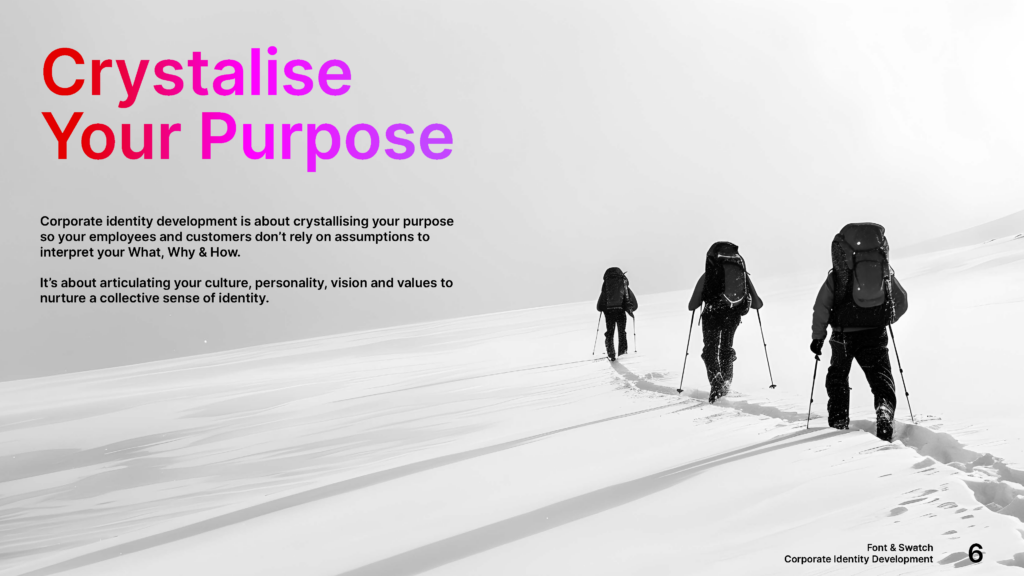
Corporate Identity development is about:
- Crystallising your purpose, so your employees and customers don’t rely on assumptions to interpret your What, Why & How.
- Articulating your culture, personality, vision and values to nurture a collective sense of identity, and so much more.
In this article, we’ll unpack Corporate Identity Development for Australian organisations and how to develop a Corporate Identity, using real-world examples to demonstrate how it benefits your organisation and the steps you need to take to experience those benefits for yourself.
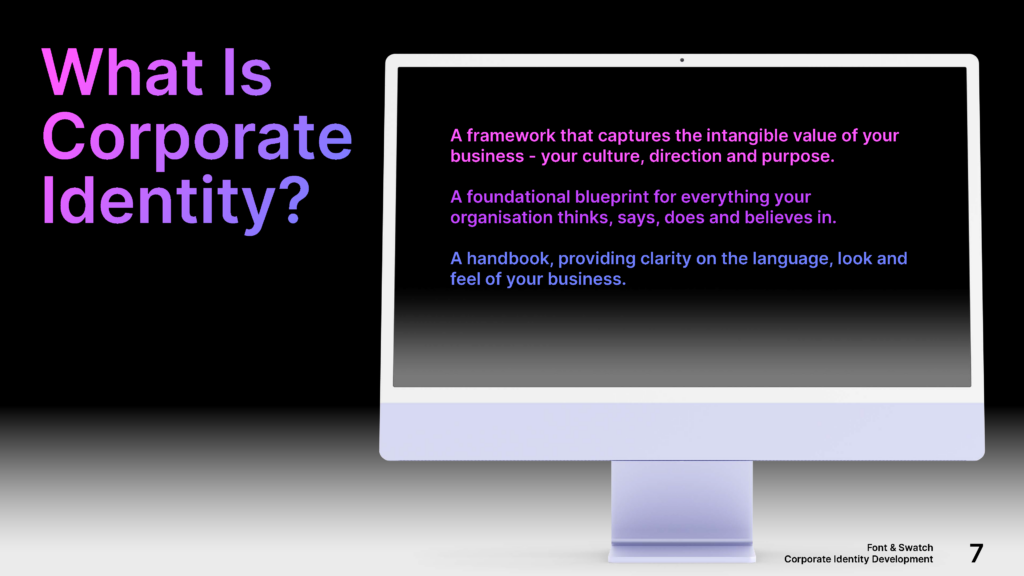
What is a Corporate Identity?
Your Corporate Identity is the articulation and manifestation of your broader organisational purpose.
Once developed, a Corporate Identity is a tangible framework that captures the intangible value of your organisation – your culture, direction and again, your purpose.
But it doesn’t stop there.
A Corporate Identity acts as a foundational blueprint for everything that your organisation thinks, says, does and believes in – it is a set of rules about how your organisation expresses itself so that your identity isn’t left up to the often-unfavourable interpretations of the masses.
How do you use a Corporate Identity?
Once you’ve defined your Corporate Identity, it needs to be clearly set out in a Corporate Identity handbook.
The Corporate Identity handbook that will emerge from the development process clarifies the language, look and feel of your enterprise.
This means that everyone inside of your organisation, particularly those driving marketing and communications, will know exactly how to express themselves and represent the company.
Why do you need a Corporate Identity?
Developing a Corporate Identity ensures that everyone in your organisation is consistent in how they present the internal and external narrative of your corporation.
A Corporate Identity also ensures that this narrative aligns with and is based on the underlying purpose and aspirations of your corporation, eliminating confusion as to WHY you do what you do.
If the Deloitte study proves correct, your corporation can potentially expect to experience:
- higher market share gains,
- growth 3x faster than your competitors, and
- higher employee satisfaction.
However, without a cohesive Corporate Identity, your organisation simply exists.
It will lack purpose and will struggle to find its unique voice, potentially leading to:
- little to no market share gains,
- slower growth than your competitors (or none at all), and
- lower employee satisfaction.
Plus, your employees will feel confused, lost and (along with the organisation more broadly) lack direction or loyalty.
The business benefits of a Corporate Identity
The benefits of building a strong Corporate Identity through Corporate Identity Development aren’t limited to those mentioned in the Deloitte case study – they are far more extensive, intersecting with every aspect of your organisation both internally and externally.
The benefits of creating a Corporate Identity include:
- Fostering greater unity and direction
- Implementing your corporate strategy effectively
- Communicating your value proposition confidently
- Establishing a consistent visual framework
- Articulating your internal culture
- Influencing positive employee behaviour and retention rates
- Guiding your corporate communications
If you don’t control your Corporate Identity, it will be determined for you.
A Corporate Identity exists whether you define it intentionally or let it grow organically.
However, without defining it, you’re not in control, and not being in control of your corporate narrative means you’re leaving your trajectory up to chance.
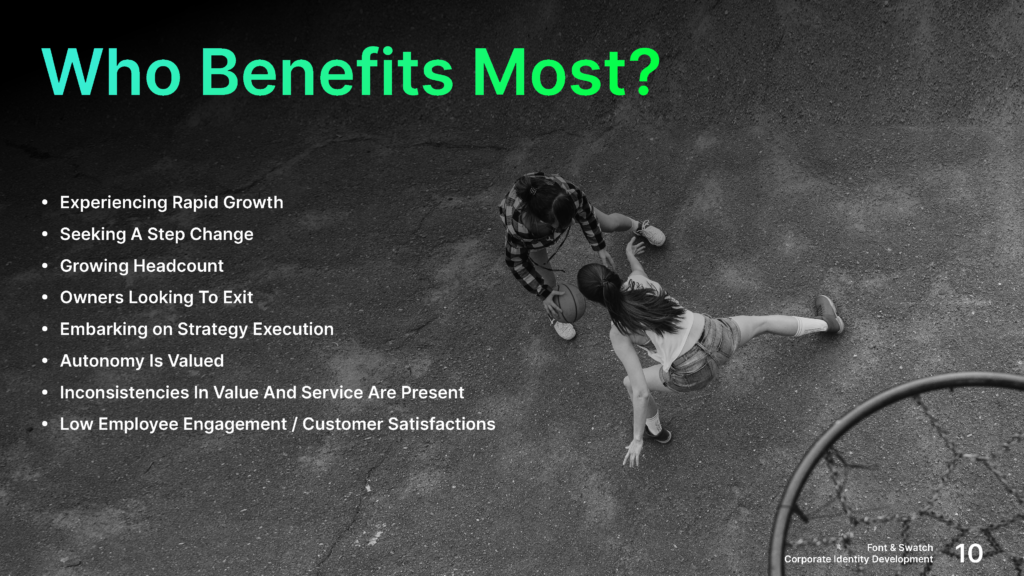
Who benefits from a Corporate Identity?
With the benefits of Corporate Identity Development clear, it’s important to distinguish who stands to enjoy these benefits.
Of course, all organisations require some level of Corporate Identity Development to crystalise their purpose and experience the benefits mentioned in the Deloitte study.
That said, Corporate Identity Development is particularly useful for organisations that are:
- Experiencing rapid growth: Corporate Identity Development ensures that new hires understand the purpose of the organisation and that the organisation maintains coherence as it expands into new markets.
- Seeking their next milestone: Corporate Identity Development facilitates a significant transformation in market positioning, helping the company shift perceptions both internally and externally to align with the change and encourage strategic growth.
- Experiencing a growing headcount: Corporate Identity development establishes a unified corporate culture, aiding in the seamless integration and alignment of an increasing number of employees during recruitment and onboarding.
- Have owners looking to exit: Corporate Identity Development enhances the market value and attractiveness of the company to potential buyers through a strong, cohesive purpose that can easily encourage buy-in.
- Embarking on strategy execution: Corporate Identity Development aligns the company’s brand and purpose with broader strategic goals, ensuring clearer communication and consistent messaging internally and externally.
- Increasingly value autonomy: Corporate Identity Development supports decentralised teams by providing a clear, consistent brand framework and values, encouraging independence while maintaining cohesiveness.
- Noticing inconsistencies in value and service: Corporate Identity Development creates a uniform purpose and vision across the company, reducing discrepancies in customer experience, communications and service quality.
- Experiencing low employee engagement or customer satisfaction: Corporate Identity Development boosts employee morale and customer loyalty by fostering a stronger, more recognisable vision for the future, culture and promise of value.
While organisations in these circumstances stand to benefit the most, Corporate Identity Development is also an important tool to prevent the above situations.
For that reason, organisations shouldn’t wait but instead, need to invest in development services and ensure that their identity is clear, cohesive and consistent for the long term.
But exactly what does a Corporate Identity look like in practice?
As discussed, your Corporate Identity is a shared enterprise-wide ethos that drives engagement, behaviours, fulfilment and belonging. At times, it may seem broad and all-encompassing, but this is by design.
Corporate Identity Development is one solution with infinite applications.
Corporate Identity Development involves two key parts:
- Your visual identity (fonts, colours, visual branding and design elements)
- Your verbal identity (corporate communications and brand messages)
Together, they combine the intangible elements of your corporation into a captivating and cohesive look and feel. Here’s what they entail.
Corporate Identity: The VISUAL Identity Guidelines

This is a manifestation of a look and feel that can be applied to all your internal and external corporate collateral and organisation materials.
It ensures that any marketing, communications or internal touchpoint has the same visual voice that communicates who you are, what you stand for and how you behave so that customers and stakeholders are clear on the purpose of your organisation.
With an emphasis on representing your Identity through branding, your Corporate Identity Visual Guidelines will provide you with a cohesive voice that connects the core elements of your organisation using:
- Colour, font & graphic elements, extension and application
- Corporate imagery
- An organisation-wide visual tone
- A digital identity
- A corporate + sales collateral expression
- An internal communication tone; and
- A collective visual expression
Corporate Identity: The VERBAL Identity Guidelines
To complement this visual identity, your organisation needs a verbal identity. This will assist all marketing and communications efforts which depend upon having a coherent and consistent message.
Your corporate communication framework will capture your culture, mission and purpose and will act as a blueprint for all future communications, empowering your team with pre-approved messages that express your identity.
Your Corporate Identity’s Verbal Messaging will address the following elements:
- Corporate Identity
- Unifying central position
- Corporate mission, vision and purpose
- Associated objectives and negative associations
- Corporate core pillars
- Approach to corporate positioning
- Corporate pride
- Corporate culture
- Corporate differentiators
- Corporate social responsibility
Understanding what Corporate Identity Development is NOT
Your Corporate Identity is a unique and integral aspect of your organisation that shapes how it is perceived both internally and externally.
While it encompasses a range of elements, it should not be confused with specific corporate strategies or operational tools.
For that reason, understanding what Corporate Identity Development is NOT is equally as important as understanding what it is and how it works.
Your Corporate Identity IS:
- Unique to your organisation: it’s the total of your organisation’s values, culture, mission, visual aesthetics, and communication style – though, it is worth much more than all of its parts. It is a distinct identity that sets you apart from competitors and helps in building a recognisable and relatable image.
- The ‘dark matter’ that knits everything together: think of Corporate Identity as the invisible force that binds all parts of your organisation. It integrates various aspects of the enterprise, ensuring consistency and coherence in how the organisation operates and presents itself.
But your Corporate Identity Is NOT:
- A strategic plan: A strategic plan outlines the long-term goals and direction of the company, detailing specific actions and resources required to achieve these objectives. Corporate Identity is more about who you are rather than where you’re going or how you plan to get there. Your Corporate Identity will support the execution of your Strategic Plan and provide a compass to set the strategic direction of the organisation.
- A business plan: A business plan provides a detailed roadmap for the corporation, covering aspects such as market analysis, financial projections, and operational strategies. Corporate Identity, on the other hand, is the embodiment of the business’s character and ethos. It may guide the business plan but does not define the tactical steps. The Corporate Identity will empower your employees with the autonomy to make decisions within the boundaries of your organisational values, culture and purpose which in turn facilitates the faster and more effective execution of your business plan.
- A sales training or coaching tool: Sales training and coaching tools are designed to enhance the skills and effectiveness of your team. While these programs can benefit from the guidance of Corporate Identity to align best practices with the company’s values, your identity does not delve into operational activities or performance metrics. A clear articulation of your value proposition which forms part of your Identity does provide your sales collateral with a consistent direction and stimulates connected audience engagement.
- A project management resource: Corporate Identity may influence how projects are managed by providing a framework of principles, but it does not provide the specific tools, plans, executions or methodologies used in project management.
- A digital marketing campaign: Digital marketing campaigns are targeted efforts to promote products or services online. At Font & Swatch, we excel in this area and often help clients disseminate their identity through channels such as social media, email, and search engines, though, these campaigns simply reflect the broader Corporate Identity to ensure brand consistency – they are not the core corporate identity themselves.
What Does a Corporate Identity Document Look Like?

You now have a comprehensive understanding of what Corporate Identity Development is, how it works and how it can benefit your organisation.
That means, it’s the perfect time to address what a Corporate Identity Document looks like.
Your Corporate Identity Document is a 40–100-page handbook that can be used as a guide for the way you communicate your organisation’s Value, Purpose and Value Proposition encompassing both visual and verbal guidelines.
But the best way to understand its value is to see it in practice. Contact Font & Swatch for a detailed example of a Corporate Identity Handbook and how a Corporate Identity can transform your business.
When do you use a Corporate Identity?

Every time your company connects with an audience, of any kind.
Your Corporate Identity should be used across everything you say and do as an organisation.
A Corporate Identity handbook acts as a communication compass, providing you with a specific, clear and consistent corporate voice that drives behaviour and expresses your true value every single time you communicate.
On one hand, the messages you receive guide your future internal and external communications and empower your team to embrace your company’s vision, mission and purpose.
At the same time, the visuals will give you a voice to articulate who you are and apply it to all your internal and external collateral, digital, strategy, operational and brand materials to reinforce your identity.
Together it gives you a framework to communicate with customers & stakeholders and employee behaviour.
So where should you start?
Talk to our Font & Swatch Corporate Identity Experts
Your Corporate Identity is a strategic foundation for your organisation to articulate its purpose to unite your team and captivate customers.
At Font & Swatch, our expert Corporate Identity Developers drill down to the core of why you do what you do, and unlock the true essence of your organisation before crafting an authentic Corporate Identity that encourages unity and loyalty among staff, stakeholders and customers.
Our Corporate Identity Developers will ensure that your organisation thrives in this ultra-competitive, high-stakes commercial world by building a meaningful, purpose-driven line of communication with those who matter most.
At Font & Swatch, we work to unlock the true power of your brand. We will make your brand remarkable.
An initial discussion is exactly what you need to set you on the course to success. Mail us at create@fontandswatch.com
For more information and to get the results your enterprise deserves, contact the team at Font & Swatch today.
