
Why the difference between a cheap logo and a professionally developed brand identity is much bigger than the price.
There’s nothing inherently wrong with a 99 dollar logo.
For a very small business testing an idea or a startup working with limited funds, inexpensive logo design can be a perfectly sensible choice.
But there’s an important distinction between buying a logo and investing in a professional brand identity.
One gives your business a basic visual identifier. The other can establish the strategic and creative foundations that shape how your business is recognised, understood and remembered.
And that difference has very little to do with whether the finished artwork looks attractive.
The real question isn’t what you’re paying for your logo. It’s what your business actually needs that logo to achieve.
What Does A 99 Dollar Logo Actually Buy You?
Online design platforms have made logos remarkably accessible.
Services such as Hatchwise, 99designs and Fiverr offer businesses different ways to commission logo design without engaging a traditional branding agency.
But they don’t all offer the same service.
Hatchwise advertises logo design contests starting at $99, where multiple designers submit concepts against a client brief.
99designs operates a similar contest model. Fiverr offers both individual freelance designers and a separate automated Logo Maker service.
These are service options, but here’s the distinction.
A low-cost logo service is generally structured around delivering a defined piece of artwork, usually from a template design or based on industry or business cliche’s. A professional branding engagement is structured around solving a much broader business problem.
And that difference becomes important when you’re building a business intended to grow.
The Most Important Part Happens Before Anyone Starts Designing
A good designer can give you what you ask for.
A good brand studio should also help you determine whether you’re asking for the right thing.
When commissioning an inexpensive logo, you’ll typically answer questions about your business name, industry and preferred colours.
Useful information, certainly.
But those answers don’t necessarily establish how your business should position itself in the marketplace.
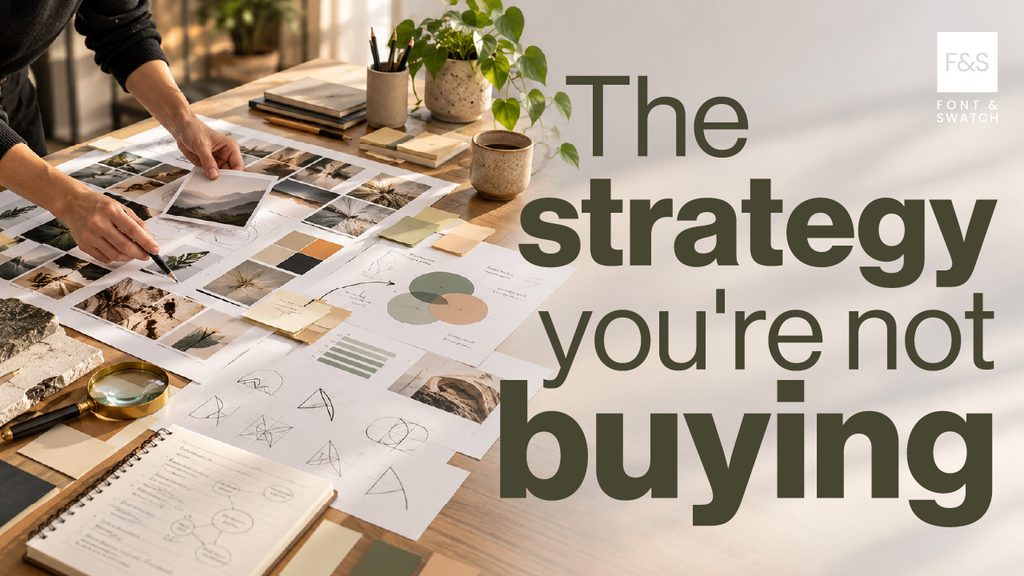
Professional brand development begins with discovery.
Who are your customers? What drives their purchasing decisions? What differentiates your business? How are competitors presenting themselves? What position do you want to occupy in the market?
And importantly, where is the business heading?
A company competing on affordability may need a very different identity from one positioning itself as a premium specialist.
A business built on trust and stability may require a different visual character from one challenging established industry conventions.
These decisions shouldn’t be based solely on personal preference.
They should be informed by business objectives, customer expectations and market positioning.
The UK’s Design Council describes this principle through its Double Diamond design process, where understanding and defining the problem comes before developing solutions.
Because designing the logo you like most isn’t necessarily the same as designing the identity your business needs.
A Logo Is Not A Brand Identity. And Your Brand Is Something Else Again.
These three terms are often used interchangeably.
They’re not the same.
A logo is a visual identifier that helps people recognise your business.
A brand identity is the coordinated visual and communication system that supports a consistent, distinctive brand.
Your brand is the collection of perceptions, experiences, expectations and associations people develop about your business.
A logo is one component of that identity.
Now consider what happens after your logo is approved.
You need a website, presentations, business cards, signage and social media graphics. Later, perhaps packaging, uniforms, advertising, vehicle graphics or exhibition displays.
Who decides which fonts to use? How should colours work together? What style of photography is appropriate? How should the brand communicate across different audiences?
Without a considered identity system, these decisions are often made independently.
And gradually, the business starts looking like several different organisations.
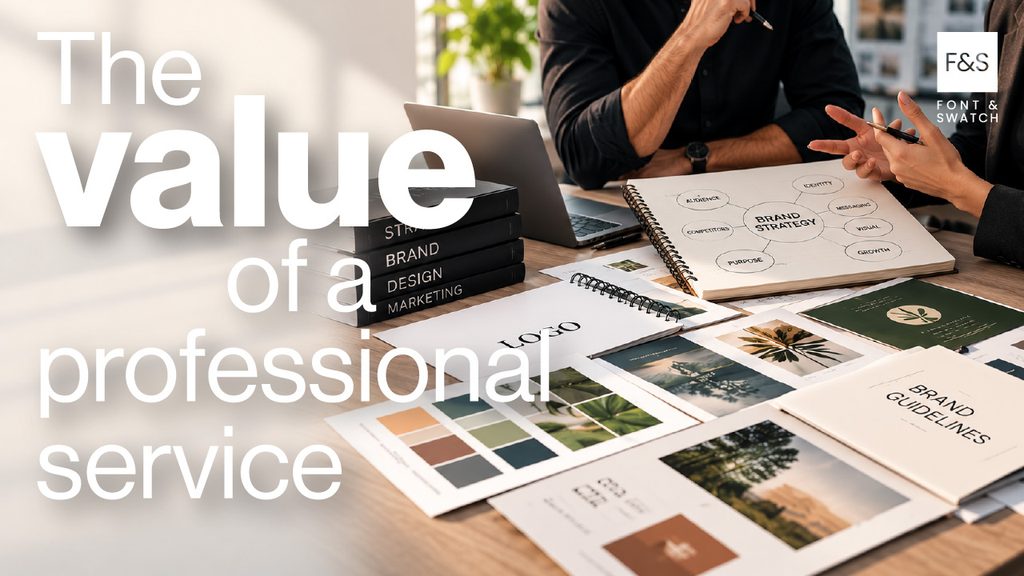
What Does A Professional Brand Identity Include?
Depending on the project’s scope, a comprehensive identity system can include:
- Logo architecture: Primary, secondary, horizontal, stacked, reversed and simplified variations, including sub-brand relationships where required.
- Colour strategy: Primary and supporting palettes, RGB, HEX, CMYK and Pantone specifications, contrast and application guidelines.
- Typography: Corporate typefaces, hierarchy, font weights, alternatives, spacing and licensing requirements.
- Graphic language: Supporting shapes, patterns, iconography, illustration, layouts and visual devices.
- Photography and imagery: Art direction, composition, subject matter and image treatment.
- Brand messaging: Personality, tone of voice and communication principles where included in the brief.
- Brand guidelines: Practical standards for applying the identity consistently.
- Brand applications: Considered examples across the business’s important customer touchpoints.
The objective isn’t to make every communication identical.
It’s to create a recognisable visual language that can adapt without losing its character.
A logo gives your business a signature. A brand identity gives it a visual language people can recognise.
Your Logo Looks Good On Screen. But Will It Work In The Real World?
This is where technical expertise becomes particularly valuable.
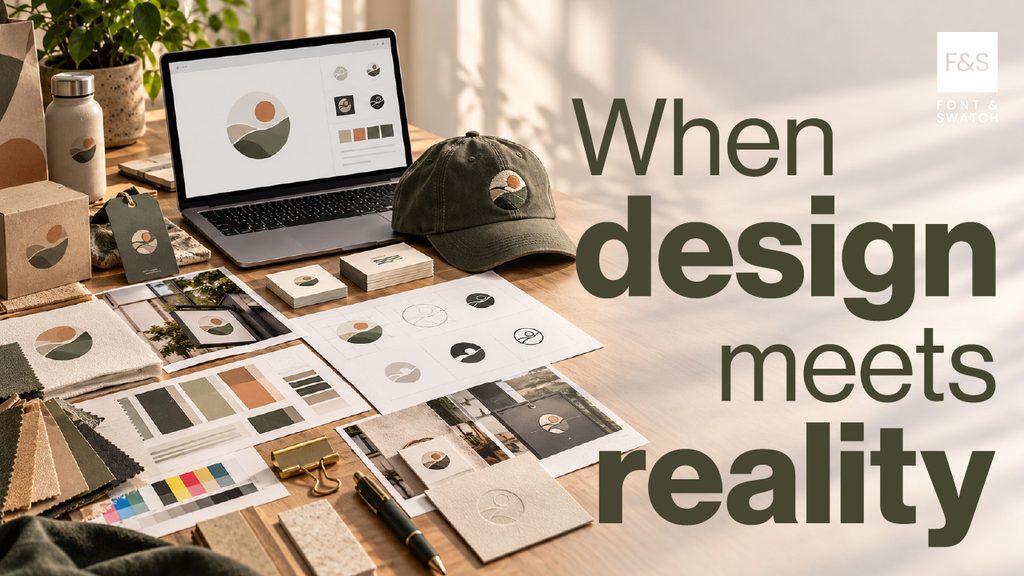
A logo can look impressive in a presentation and still cause considerable problems when it enters production.
Consider colour, the vibrant blue you approved on your computer might reproduce quite differently when printed using conventional CMYK inks.
That’s because RGB screen colours and CMYK printing colours operate within different colour gamuts. Some highly saturated digital colours cannot be reproduced exactly through standard four-colour printing.
Then there’s the physical application.
Fine lines can disappear during embroidery. Intricate details may become indistinct at small sizes. Gradients can create complications for certain production methods. Delicate typography might become unreadable on merchandise or signage.
These aren’t unusual problems.
They’re everyday production considerations.
The Correct File Doesn’t Guarantee the Correct Result
Most professional logo services can supply vector artwork, commonly in formats such as EPS, SVG or PDF.
That’s important.
Unlike raster artwork, vector graphics can be scaled without losing their geometric definition.
But receiving an EPS file doesn’t automatically mean your logo will reproduce successfully at every size or on every material.
A vector file won’t prevent fine details disappearing in embroidery. Nor will it guarantee accurate colour reproduction or an economical manufacturing process.
Those outcomes depend on the design itself and the production method.
A professionally developed identity may require simplified small-size versions, single-colour artwork, alternative layouts and application-specific specifications.
It should also be tested in the environments that matter to your business.
For a retailer, that might mean packaging, signage and shopping bags.
For a sporting organisation, it could involve apparel, merchandise, broadcast graphics, sponsorship and venue signage.
A logo shouldn’t simply look good when it’s presented. It should work where your customers will actually see it.
The Most Valuable Thing A Design Studio Offers Might Be the Advice You Didn’t Know You Needed
When businesses engage an experienced design studio, they’re buying access to knowledge and judgement as well as creative expertise.
And sometimes, the most valuable contribution is identifying a problem and designing out of the identity before it becomes expensive.
Your preferred logo might look too similar to a competitor.
A particular colour palette may create unnecessary production costs.
Your proposed visual identity might struggle to accommodate future product ranges, or it may not connect with your intended audience, or the brand name you’re considering could present practical problems in another market.
A responsible studio should recognise these issues, explain the implications and recommend alternatives.
That doesn’t mean overriding the client’s decisions.
It means helping business leaders make more informed ones.
There’s also the value of implementation.
Professional branding services usually extend into artwork preparation, supplier coordination, proofing, templates, rollout planning and ongoing creative direction.
Those services are rarely included by the value driven logo platforms.
But access to experienced people who understand the thinking behind your identity can become particularly valuable as your business develops.
What About Copyright, Licensing and Trade Mark Protection?
This is one area where businesses need to look carefully at what they’re purchasing.
Commercial usage rights, copyright ownership and trade mark registration are different things.
Some design services transfer copyright in the commissioned artwork. Others provide commercial licences with specific limitations.
For example, Fiverr’s Logo Maker provides non-exclusive commercial usage rights, but does not grant exclusive ownership of the underlying design or permission to trade mark it under that product’s terms.
The Hidden Cost Of A Cheap Logo Is Sometimes Paying For It Twice
A low-cost logo often appears to represent excellent value.
Until it doesn’t.
Imagine investing in signage, packaging, uniforms, websites, vehicle graphics and advertising around an identity that later proves unsuitable.
Perhaps it lacks distinction. Perhaps it creates technical reproduction difficulties. Or perhaps the business has grown beyond the image it originally adopted.
Changing the logo may be straightforward.
Replacing everything that carries it can be considerably more expensive.
There’s also the less visible cost of an identity that doesn’t support your market position.
If your business provides premium services but looks indistinguishable from budget competitors, your visual presentation may be working against your commercial objectives.
A strong identity won’t compensate for poor products or service.
But a poorly considered identity can make an otherwise good business harder to differentiate and market.
The cost of a logo isn’t necessarily what you paid to create it. It’s also what you’ll spend making it work.
So, Is A 99 Dollar Logo Ever The Right Choice?
Sometimes.
A startup testing an idea, a temporary venture, a community project or a business with very limited resources may have perfectly valid reasons to choose an inexpensive logo.
Equally, paying more for a design studio doesn’t automatically guarantee better work.
The important consideration is matching the service to the requirements of your business.
If you need a basic visual identifier to get you by until the business is ready to invest in a brand identity, a straightforward design service may be entirely appropriate.
If you’re investing in long-term growth, multiple customer touchpoints, complex production requirements or market differentiation, a broader branding process deserves consideration.
Eight Questions Worth Asking Before You Commission A Logo
Before choosing your designer or branding agency, ask:
- Research: Will they investigate your business objectives, customers, competitors and market position?
- Strategy: Can they explain why the recommended design direction is appropriate for your business?
- Deliverables: Are you buying a logo, logo variations, a basic style guide or a comprehensive identity system?
- Technical performance: Has the artwork been considered for the materials, sizes and production methods you’ll actually use?
- Ownership: What copyright, commercial usage, font licensing and trade mark considerations apply?
- Implementation: Can the provider assist with suppliers, artwork preparation and introducing the identity?
- Artwork quality: Will you receive the appropriate vector files, colour specifications and reproduction guidelines?
- Professional advice: What happens if research reveals that the original brief isn’t the right solution?
The answers will tell you considerably more about the value of a proposal than its headline price.
The Bottom Line: Know What You’re Buying
A professionally developed logo and a professionally developed brand identity are not the same purchase.
One may provide a visual identifier.
The other can bring together business insight, market research, strategic positioning, creative development, technical expertise and practical guidance.
At Font & Swatch Branding Agency Sydney, we create brand identities built on strong foundations, combining strategic thinking with the technical and creative expertise needed to bring those identities to life.
Because powerful brands aren’t built by choosing the most attractive logo from a selection of options.
They’re built through considered decisions about how a business should be positioned, recognised and experienced.
And those decisions need to continue working long after the original artwork has been approved.
The question isn’t whether a 99 dollar logo can look ok.
It’s whether looking ok meets the potential of your business
